Degenerative Lumbar Scoliosis
A 62-year-old female patient presented with complaints of long-standing low back pain, pain radiating to both legs, numbness, and difficulty walking. Her back pain increased with sitting, decreased with lying down, and radiated from her back to both hip areas. Her walking distance had shortened to 50 meters, after which she felt the need to stop due to numbness and pain in her legs. The patient's complaints did not improve despite medical and physical therapy approaches.
The patient's examination revealed no significant findings other than local tenderness in the back and gait disturbance. Her neurological examination showed no loss of strength or sensation.
Direct radiographs and MRI showed degenerative type lumbar scoliosis, spinal canal stenosis at the L4-L5 level, and segmental instability (slippage) at the L3-L4 level. The scoliosis angle was 20°.
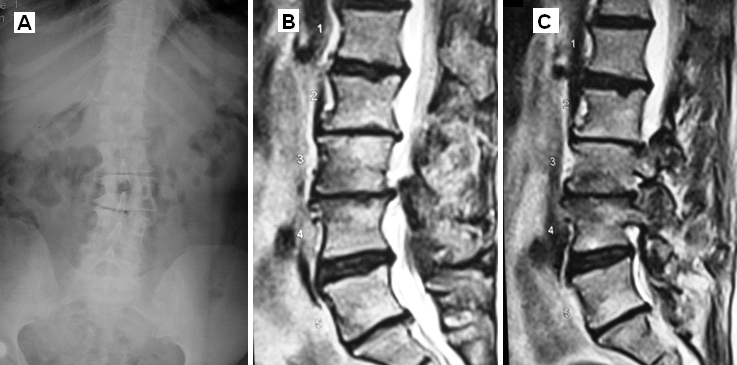
Figure 1: The degree of lumbar scoliosis (20°), lateral slippage (listhesis) due to scoliosis at the L3-L4 level, and degenerative changes are visible.
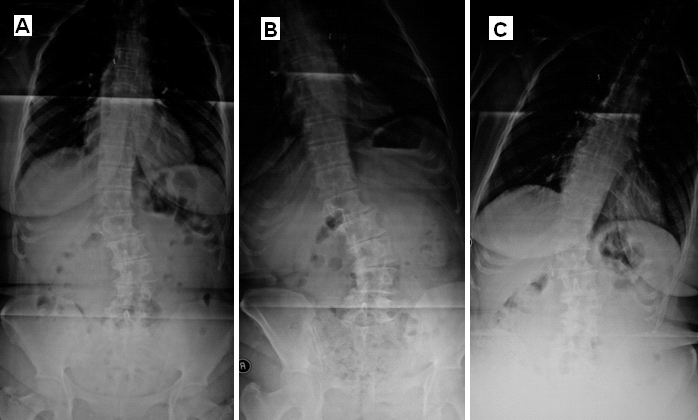
Figure 2: MRI shows the spinal canal is narrowed from the front and back at the L4-L5 level (spinal stenosis), and the L3-L4 disc is significantly worn out.
Surgery
Considering the patient's complaints, radiological findings (scoliosis, instability, spinal stenosis), and unresponsiveness to conservative treatment, surgical intervention was decided. The patient underwent decompression and fusion surgery at the L3-L5 levels. Bony and soft tissues compressing the spinal cord and nerve roots at the L4-L5 level were removed (decompression) to relieve the nerves. Subsequently, stabilization (fusion) was provided using pedicle screws and rods from L3 to L5. An interbody cage was placed at the L4-L5 space to support the segment and partially correct the scoliosis.
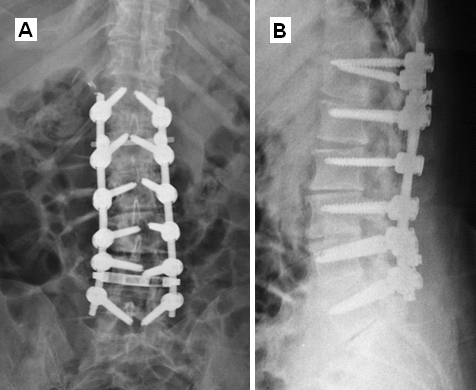
Figure 3: The postoperative plain radiograph shows the fusion achieved with the pedicle screw and rod system applied at the L3-L5 levels. The interbody cage placed at the L4-L5 space helped correct the spinal alignment.
Follow-up
The patient recovered quickly after the surgery, and her leg pain and difficulty walking complaints almost completely resolved. Shortly after, she was able to continue her daily life and walks without problems. The patient is currently under our follow-up.
Comment
Adult degenerative scoliosis is a condition characterized by the lateral curvature of the spine due to wear and tear in the discs, facet joints, and ligaments with age. It usually presents with low back and leg pain (due to spinal stenosis). Surgical treatment is necessary in scoliosis cases that do not respond to conservative treatment and have neurological symptoms. The goal of treatment is to relieve the nerves (decompression), correct the scoliosis, and stabilize the spine (fusion). The length of the fusion (how many levels it will cover) is determined by the degree of scoliosis, instability, and the level of stenosis. In this case, a satisfactory result was achieved with L3-L5 stabilization.